How to Prevent Quality Issues with a Zero-Defect Approach
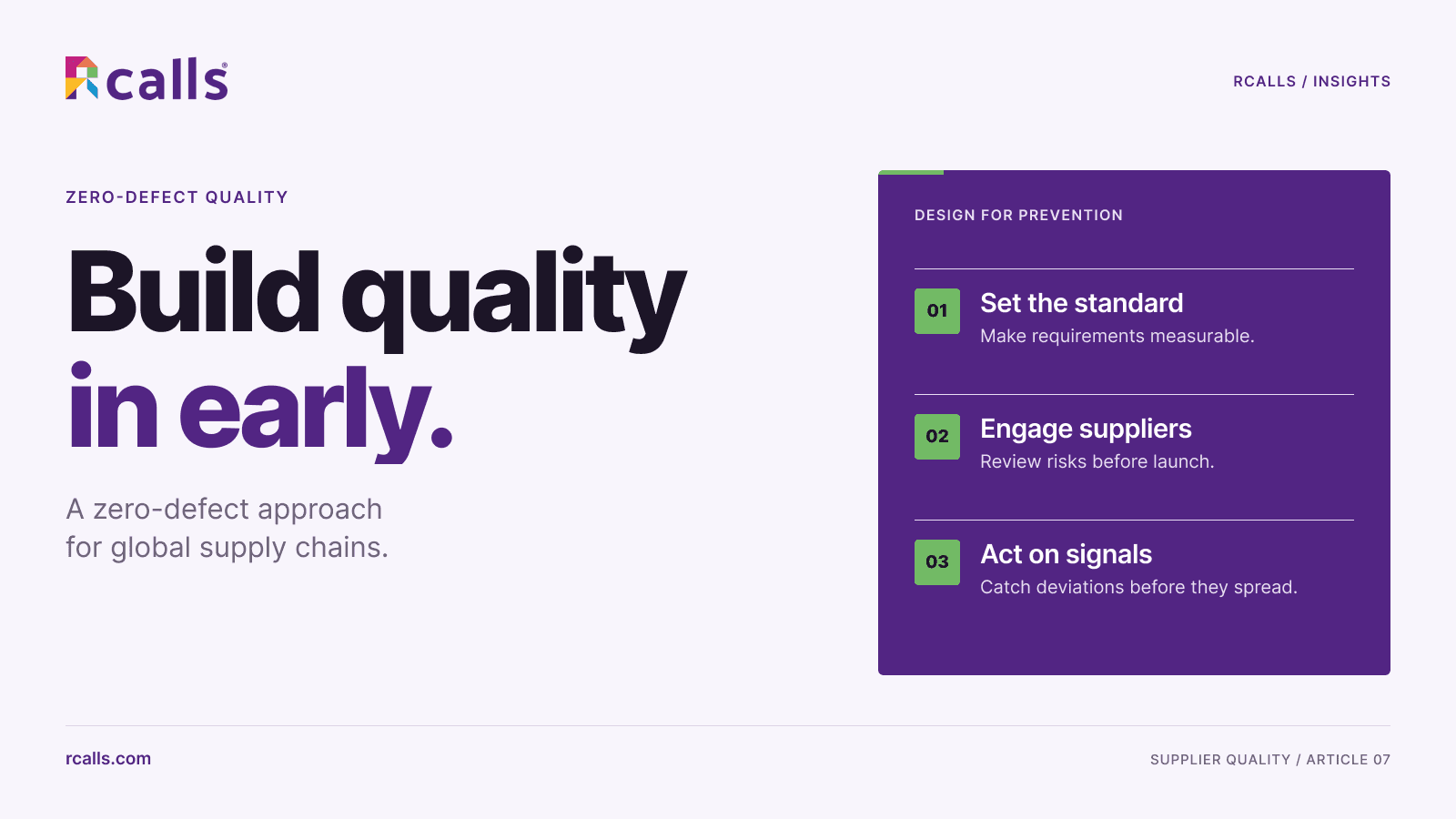
Build quality in early: align supplier standards, review risks before launch and act on recurring deviations before they spread.
A part that fails final inspection has already consumed material, machine time and labour. Inspection can keep it from reaching the customer. The earlier opportunity is to prevent the defect from being made in the first place.
That is the practical idea behind zero-defect quality. Treat zero defects as a goal and build prevention into how you define requirements, work with suppliers and respond to deviations. In a global supply chain, each of those steps depends on people seeing the same information in time to act.
Why small deviations become bigger problems
A supplier may be working from an outdated specification. A plant may log a recurring issue in a spreadsheet that another plant never sees. An inspection result may arrive after the next batch is already in production. Each gap makes it harder to spot a pattern while the affected population is still small.
We explored this visibility problem in The Limits of Spreadsheets in Quality Risk Management. A preventive approach gives suppliers and quality teams shared expectations, traceable records and a clear path from a signal to a decision.
Three ways to build prevention into the process
1. Make the quality standard measurable
Agree on the current specification, acceptance criteria and evidence required for each critical characteristic. Make it clear who owns the requirement and how changes are communicated. A shared, current standard gives teams a basis for spotting a deviation and deciding when it needs attention.
2. Bring suppliers in before launch
Review foreseeable failure modes, process changes and inspection plans with suppliers while there is still time to change the process. Continue the conversation during production with regular reviews of recurring nonconformities, response times and corrective actions.
3. Act on early signals
Look for repeated deviations by component, lot, process or supplier. When a pattern appears, identify the potentially affected population, agree on containment, and assign someone to investigate the cause. Follow up after the corrective action to check whether the issue recurs.
Start with one recurring defect
Choose a defect that has appeared more than once. Ask whether the team can quickly see the part and lot, the current specification, what happened, who owns the response, and whether the fix held. Each missing answer points to a specific improvement.
Record the same minimum information across plants and suppliers.
Agree on who reviews a recurring signal and when to escalate it.
Check subsequent lots or production runs before closing the loop.
Earlier visibility can help limit disruption, reduce repeat work and give quality and warranty teams better evidence about which failures might recur.
Put the evidence to work with Rcalls
Rcalls helps manufacturers track defects, investigate root causes and follow corrective actions in a shared quality process. Talk to Rcalls about connecting supplier-quality records and acting earlier on recurring issues.
Further reading: SupplyOn, “How to maintain zero-defect quality in a global supply chain.”
Topics
Part of the team at Rcalls researching and writing about automotive quality management, warranty operations, and insurtech.
Related articles
See how Rcalls connects quality and warranty data
Book a 30-minute demo tailored to your manufacturing or insurer use case.
Request a demo →